
ClustersEpisode 59 8:08 13 chapters November 2026
Design Clusters on a Canvas: Replica Sets, Galera, Gateways and HTTPS
Design a cluster on a canvas: API Maker on several servers behind a gateway, databases clustered over the servers you pick, a MongoDB replica set, MariaDB as a Galera cluster, Caddy, Ferron or Pingap as reverse proxies with their own domains and Let's Encrypt certificates, and every rule checked before anything is deployed.
In the playlists The complete course Launchpad
Chapters
What you will learn
- The canvas: drag and drop, and the drop says what it does
- More API Maker servers, and the gateway that follows them
- Caddy, Ferron and Pingap
- What the canvas refuses
- A MongoDB replica set, and MariaDB as a Galera cluster
- Menus, settings and the keyboard
- How a cluster is deployed
Transcript1058 words · click a time to play from there
Intro
You can design a cluster on a canvas. API Maker runs on several servers behind a gateway. Databases are clustered over the servers you pick. Reverse proxies get their own domains. And every rule is checked before anything is deployed.
Clusters, the usual way
A cluster usually means a lot of manual work. You set up replica sets, streaming replicas, and Galera by hand, node by node. You configure a load balancer, and update it for every new server. You get certificates, and renew them. And you draw it on a whiteboard that nothing checks. With Launchpad, you shift click the servers, and the database is clustered over them. The gateway follows every API Maker server you add.
The reverse proxy gets and renews Let's Encrypt certificates. And the canvas refuses what cannot work, and says why. In this video: the canvas, more API Maker servers, the gateway and its load balancing, what the canvas refuses, clustered databases, the own MongoDB and Redis of API Maker, reverse proxies with their own domains, and how a cluster is deployed.
The canvas
Here is the architecture of production, on the load balanced layout. There is the gateway, app-1 for API Maker, and data. On the left is the palette, and on the right is every component. Drag PostgreSQL from the palette. The servers that can take it are outlined, and the one under the pointer says what the drop does. Drop it on data. Name it orders. It is saved. Click on a server to open its box.
You can connect it, see what can be added there, and see what it runs, each with its own move and remove.
More API Maker servers
Drag API Maker from the palette, onto the place for a new server. app-2 is planned, and it runs API Maker. Now API Maker runs on two servers, and the gateway sends requests to both. It follows every API Maker server added later. Each API Maker server needs its own license key.
The gateway
The gateway is Caddy, sending the requests to every API Maker server. You pick its load balancing: the fewest requests in progress, each server in turn, the same visitor on the same server, or active and standby. You can change its kind, to Ferron, written in Rust, or Pingap, built on Cloudflare Pingora. Caddy is the default. There are three reverse proxies. All of them get and renew certificates from Let's Encrypt by themselves.
Caddy checks the API Maker servers, and reloads without dropping a connection. Ferron leaves out a server that fails, and tries the request on the next one. Pingap applies new routes and servers without dropping connections. A new configuration is checked first. If the reverse proxy refuses it, it stays as it was.
What the canvas refuses
Now drag the API Maker of app-1 onto app-2. app-2 runs it already, and the canvas says so, in red. The drop changes nothing. The same rules hold everywhere. API Maker runs once per server. There is one reverse proxy per server. Every Galera node is on its own server. A database that runs only on x86 cannot go on an ARM server. And a Full Docker environment is on one server.
Databases clustered
Click data, shift click app-1, and gateway. Three servers are picked. The panel lists what can be clustered over them: a MongoDB replica set, and PostgreSQL, MySQL, MariaDB, and Percona with their replicas. SQL Server, Oracle, and TiDB run as single nodes. Put MongoDB over them, as a replica set, with one member on each server, and the primary on data. Every member keeps a full copy of the data.
When the primary stops, the others elect a new one within about ten seconds, and API Maker follows it by itself. Name it catalog. It is added, and drawn over the three servers with its replication.
API Maker's MongoDB and Redis
Pick the same three servers again. The own MongoDB of API Maker becomes a replica set over them. And once more. Its Redis becomes a cluster. The keys are shared out between at least three masters, each with its replica.
MariaDB as a Galera cluster
For the marketing data, put MariaDB over the three servers. It can be a primary with replicas, or a Galera cluster, where every node reads and writes. Name it marketing, and add it. Every cluster is drawn, server by server. PostgreSQL can be a primary with streaming replicas, synchronous if you want. MySQL and Percona can be a source with replicas. MariaDB can have replicas, or be a Galera cluster.
MongoDB can be a replica set. In the panel of a database, its servers are chips. Choosing a second server turns a single node into a cluster, and back.
Reverse proxies and domains
Drag Caddy from the palette, onto app-1, next to its API Maker. It is a direct reverse proxy. It sends the requests only to the API Maker of its own server. Give its addresses: three domains of Calm Home, for the admin panel, the API, and the WebSockets, over HTTPS. Add an email, so that ZeroSSL takes over if Let's Encrypt ever fails. It is saved. Apps reach app-1 directly, and the gateway stays the entry of the environment.
Right click on any component to open its menu. Here, the reverse proxy can become a second gateway, to every API Maker server. The Settings of the environment list every reverse proxy, with its addresses, and open the architecture on the one you want to change.
The keyboard
Everything on the canvas works with the keyboard too. Tab goes to a server or a component. Enter selects it, and Shift Enter adds a server to the selection. Shift F10 opens its menu. Delete removes what is selected, and Escape lets go.
How a cluster is deployed
When deployed, a cluster comes up in order. Every server is prepared, and its databases start. Then the replica sets and the clusters are formed. The replicas and the other nodes join. And the replication is checked. API Maker starts last. When several servers already serve traffic, it starts them one at a time, so the gateway always has one to send requests to.
Recap
To sum up. You drag and drop, and the drop says what it does. You add API Maker servers, and the gateway follows. Databases are clustered over the servers you pick. Reverse proxies get their own domains and certificates. And the canvas refuses what cannot work. Next: Launchpad, every day. API Maker. Build faster, spend smarter, deliver better.
Keep watching
 Length 8:09Day two
Launchpad Day Two: Upgrades, Health, Logs and Moving Data Between Servers
 Length 7:03Scale out
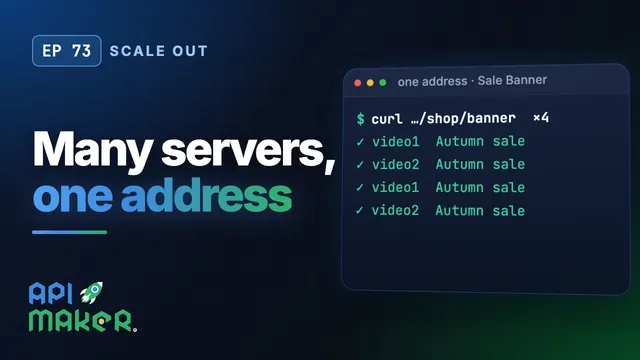
Scale Out a Backend: Many API Maker Servers Behind One Load Balancer
 Length 8:20Native APIs
Node.js, Python, Go and Java for Native APIs, Installed for You
 Length 7:42Upgrade from v3