

Playlist · 73 videos · 7 h 19 min
API Maker v4: the complete course
Every feature of API Maker v4, one video each, on the real admin panel with the data of Calm Home, an online shop on six databases. Follow it in order, or jump to the topic you need.
The videos of this playlist
 6:561. Architecture
How API Maker Works: The Life of a Request, from Your App to Your Data
How API Maker works, in six minutes: the life of one request through Caddy, the token and groups, your hooks, the API and one envelope. Then the four families of APIs, the two tokens and their gates, where your code runs in eight languages, the servers, what a save does and why everything is in git. 5:442. Quick start
Your First API in 10 Minutes: The API Maker Quick Start
The API Maker quick start, in ten minutes: a new account comes with a sample shop on MongoDB. Set one connection string and a password, get a token, save a category and a product through their schema, read them back with a relation, and see a refusal with every error in one answer. 7:363. Web and mobile
Call Your API Maker APIs from a Web or Mobile App: Tokens, CORS, Errors and Types
A real web shop in plain JavaScript calls API Maker from the browser: the token of the app from a public custom API (the password stays in the secret), pages of products with select, sort, limit, skip and the total, a customer who signs in for a token of their own, an expired token refreshed without the customer noticing, errors shown under their fields, allowed origins, types from the schemas, and the same calls from Swift and Kotlin. 3:594. Panel tour
API Maker Admin Panel Tour: Find Any Page in Two Keystrokes
API Maker puts your whole backend in one admin panel. In under four minutes, learn where everything lives: the welcome dashboard, search, the menus of the top bar, the Command K palette, the user menu and the tools, light and dark themes, and the three kinds of users. 5:465. Databases
Connect 6 Databases and Get REST APIs for Every Table
Connect MongoDB, MySQL, MariaDB, PostgreSQL, SQL Server and Oracle to one API Maker backend. Connection strings stay in a secret on the server, every instance is tested before it is saved, and every table answers REST APIs without a line of code. 11:066. Table designer
Create Databases and Tables in the Panel: One Designer, Six Engines
Make databases and tables on MongoDB, MySQL, MariaDB, PostgreSQL, SQL Server and Oracle right in the API Maker panel. Design column by column, read the statements written for your engine before they run, run scripts of your own, edit tables as ALTER statements, and keep the schemas of API Maker in step, both ways.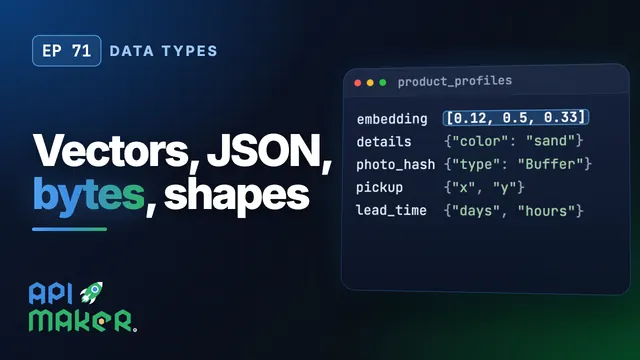 5:087. Data types
Vectors, JSON, Bytes, Shapes and Intervals Through One REST API, on Six Databases
Every column type of MongoDB, MySQL, MariaDB, PostgreSQL, SQL Server and Oracle goes through the same APIs as plain JSON: AI embeddings as lists of numbers, JSON as JSON, bytes as one Buffer object, shapes as GeoJSON, intervals as objects. Shown on MariaDB 12.1 vectors, MongoDB BSON vectors and PostgreSQL.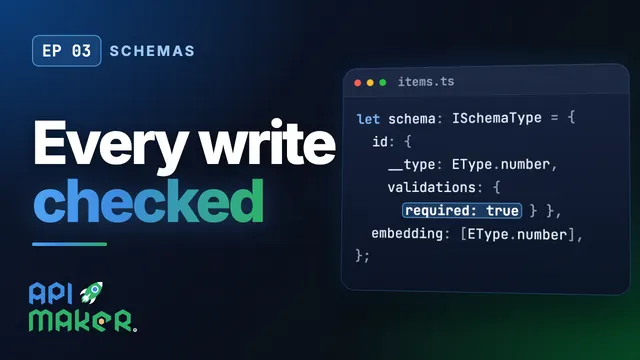 5:438. Schemas
Table Schemas in TypeScript, Checked on Every Write
In API Maker, the schema of a table is TypeScript written from the real table, kept in Git, and checked by the server on every write, whoever writes. Follow the rules of the support tickets of Calm Home: validations and conversions, nested objects and arrays, vectors and JSON, invented keys refused, and a schema compared with its table. 5:349. Data safety
Encrypted and Hashed Fields, Auto Increment and Optimistic Locking
Encryption, hashing, auto increment numbers, generated ids and updates that never erase each other: in API Maker each one is a key in the schema of a table, on MongoDB as on SQL. See what the database really holds, how your code reads it back with the secret, and how a stale update is refused.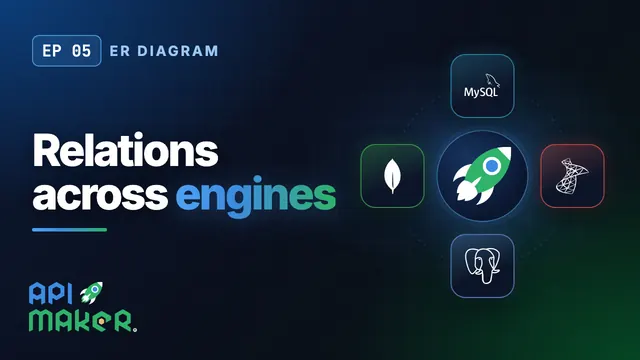 4:0710. ER diagram
Relations Across Databases and the ER Diagram
A few keys in a schema link two tables, whatever their engines: the shipments of the warehouse meet the orders of the shop. Typos are caught when the schema is saved, and deep populate, find and join, master save and the ER diagram all follow the relation.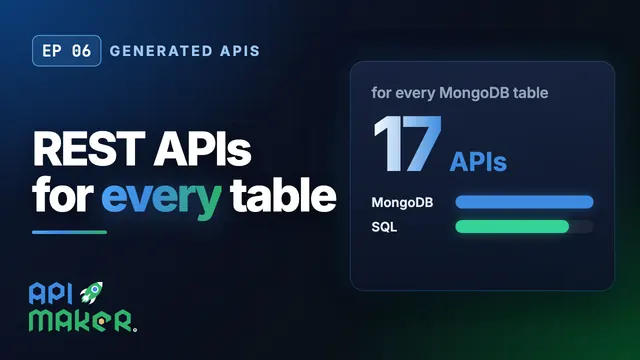 4:1911. Generated APIs
Instant REST APIs for Every Table: A Tour of the Generated APIs
Every table answers REST APIs without a line of code: seventeen operations on MongoDB and fourteen on SQL, in two families, SCHEMA and GEN, with one envelope for success and error. Take the tour from the panel, from a terminal with curl, and in the Swagger docs of an application.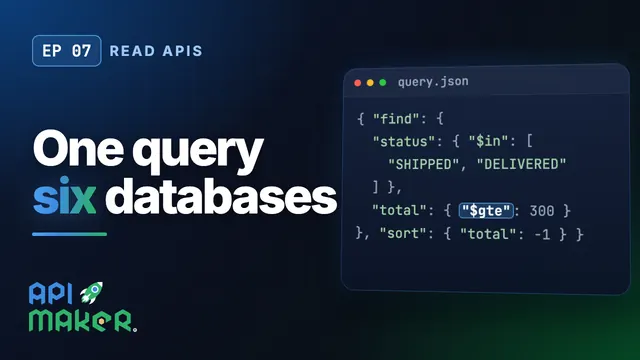 5:0112. Read APIs
One Query Language for Six Databases: find, select, sort, aggregate
Read data the same way on MongoDB, MySQL, PostgreSQL, SQL Server, Oracle and MariaDB: find, select, sort and limit, with the operators of MongoDB, on every engine. See one query asked in three dialects, every operator on SQL, count, distinct, an aggregate, and a million rows streamed.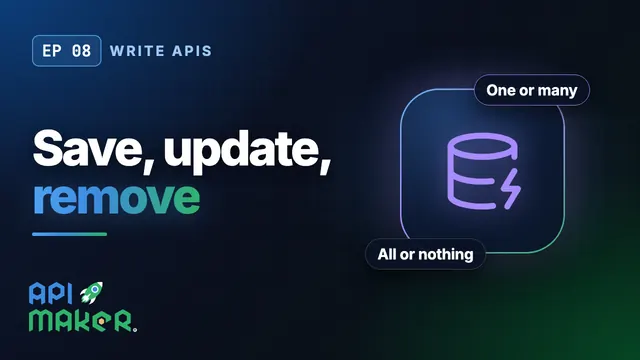 3:2513. Write APIs
Save, Update and Remove on Any Database with the Same API Calls
Save one row or many, update and remove by a filter, push into an array or pull from it: the same calls on every engine. See a batch with one bad row refused before anything is written, the coupons of a festival updated in one call, and a wishlist changed in place on MongoDB. 3:1614. Master save
Master Save: Write a Tree of Rows Across Databases in One Call
One call writes a tree of rows: a customer in PostgreSQL, her order and its lines in MySQL. Each row gets the id it needs, and when one row is wrong, nothing is written in any database. Then the whole tree is read back with deep.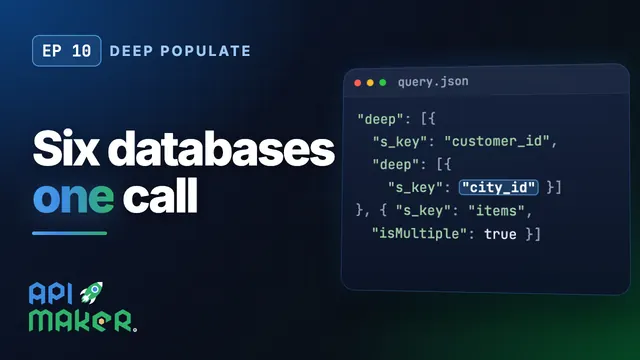 8:4315. Deep populate
Deep Populate: Join Data Across Six Databases in One API Call
Deep populate swaps the ids in your rows for the rows they point to: one call, any depth, in one database or across six engines. An order comes back with its customer and city from PostgreSQL, its coupon from MariaDB, its employee from Oracle, its lines from MySQL with their products from MongoDB, and its shipments from SQL Server. 4:5116. Virtual fields
Virtual Fields: One-to-Many Relations Across Databases
Deep fills an id with the row it points to. A virtual field goes the other way: the rows of another table that point back here, like the orders of a customer, in one call, even from another database. Declare it in the schema, read a customer with their orders, reviews and tickets from three databases, and shape every level.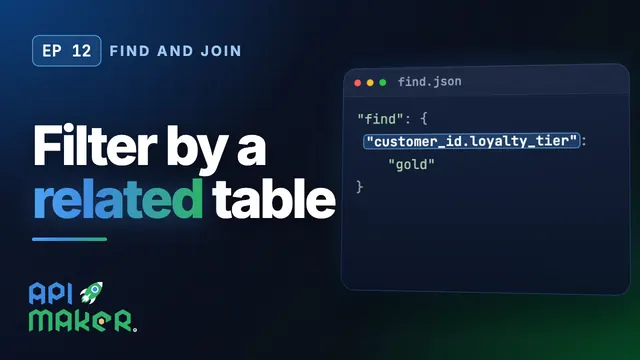 4:1617. Find and join
Filter by a Related Table, Even in Another Database: Find and Join
Filter rows by a related table, even when it lives in another database: a dot in find follows the relation, like customer_id.loyalty_tier. See it in one database, across two engines and three, why the innermost table is queried first, and the same in counts and updates. 3:5118. Request headers
Shape Every API Answer with Request Headers: camelCase, XML, YAML, Flat
The client chooses the shape of the answer, with no code on the server: the case of its keys, JSON, XML or YAML, nested or flat, with its timing in meta, encrypted, or compressed. One request header each, on every API of API Maker.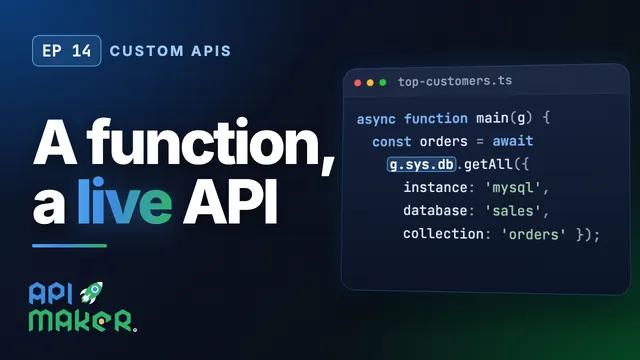 5:1419. Custom APIs
Your First Custom API: From a Function to a Live Endpoint
A TypeScript function becomes a live API: no project to scaffold, no routes, no build, no deploy. Write Top Customers of Calm Home in one dialog, with every instance, database, table and column completed by the editor, save it, call it, and switch versions in a click.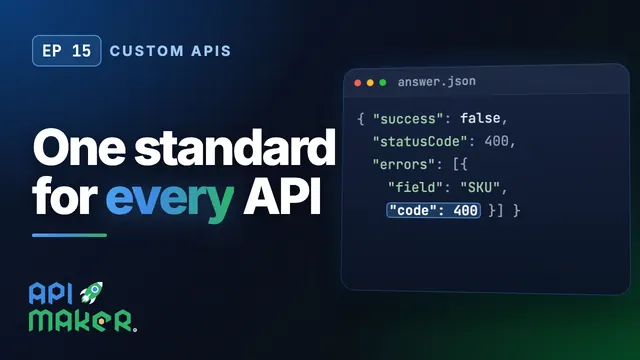 9:0420. Custom APIs
Custom APIs on One Standard: Validation, Standard Errors, Fast Fixes
Your own code, kept on one standard whoever writes it: one envelope for every API, request schemas that validate and clean input without code, standard errors in every language, typed tables from Generated Interfaces, and a real bug found from its stack and line, fixed and live again in seconds. 6:5221. Custom APIs
Custom API Gems: Uploads, Downloads, npm Packages, a Browser, Caching
The things most teams build by hand around their code, ready in a custom API: file uploads checked before the code runs, downloads by file name, any content type, external calls side by side, npm packages in a click, Chromium in a sandbox group of its own for PDF invoices, and caching in one line.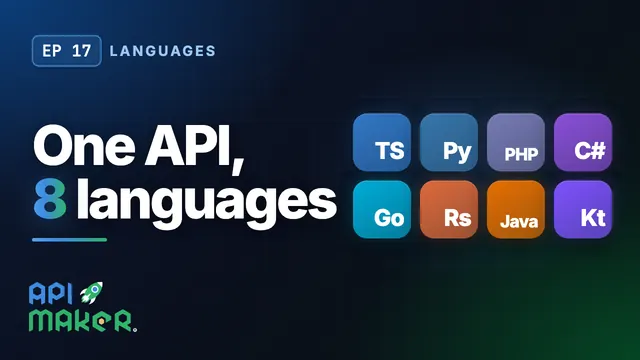 4:4422. Languages
One API in 8 Languages: TypeScript, Python, PHP, C#, Go, Rust, Java, Kotlin
One custom API, written eight times: TypeScript, Python, PHP, C#, Go, Rust, Java and Kotlin. Each team writes the language it knows, with the same typed g object, and every API answers the same way. See the language picker, eight calls with one answer, code compiled when saved, and a compile error in the console.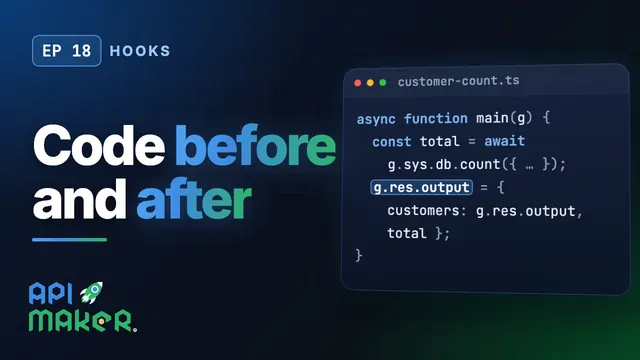 6:0123. Hooks
API Hooks: Run Your Code Before and After Every API
A rule written once, for a whole database, one table or one API: pre hooks run before the API, post hooks after it. Watch the hooks of Calm Home cap reads at fifty rows, keep their order, mask phone numbers in answers, get tested alone with Test Hooks, and see a loop between hooks stopped by API Maker. 4:3124. System APIs
System APIs: Encryption, Hashing, Tokens and Redis, Ready to Call
Encryption, hashing, tokens, Redis keys, data checks, table meta, indexes and events: APIs every API Maker account already has, closed by default and opened one by one. Use them from the panel, from a terminal and from your code. 4:4825. Utility classes
Utility Classes and Process Initializers: Shared Code, Loaded Once
Code that many APIs share, and code that runs once when a process starts. Write a utility class of Calm Home, use it in two APIs, change it once and see both follow, then load data in a process initializer before the first request. 4:2326. Events
Event-Driven APIs: React to Saves, Code and HTTP Calls
Code that reacts to what happens: after a save, from your code, or over HTTP, without a queue or a worker to run. Follow the events of Calm Home: an order saved, a row written behind the answer, a chain of events emitted from code, and a careless loop stopped by API Maker. 4:0627. WebSockets
WebSockets Without a Realtime Server: Push Live Data from Your APIs
Live data for your apps from the same server as your APIs: a save, a status, pushed the moment it happens. Follow Kabir, a customer of Calm Home: one WebSocket, his orders live, a status pushed from code with emitEventWS, a rule for each subscription, and how far it scales. 6:1028. Schedulers
Schedulers: Cron Jobs Without a Cron Server
Code that runs on a clock: every minute, every night, or on weekdays at nine. No cron server, no double runs, and every run on record. Build a low stock alert for the buyers of Calm Home with intervals and cron expressions, run it now, pause it, give it a timeout, and see it run once per cluster with failover. 6:0529. Authorization
API Authorization Without Auth Code: Access Types, API Users, Groups
Who may call which API, read which column and write what: set once, checked on every call, with no line of auth code. The support desk of Calm Home gets its own key: public, token or no access per API, an API user with its password in the secret, groups that name tables, APIs and columns, and a token that only reads. 7:2530. Auth providers
Sign-In for Your Users: DB Token Generator, Custom Tokens and SSO
Your app has people: customers, staff, partners. Auth providers let them sign in and tell every API who is calling, without one line of login code: a DB token generator over your own table with hashed passwords, signed and refreshed tokens, a custom token generator, single sign-on with Google, Azure AD and AWS, and g.req.auth in your code. 5:1531. Roles
Role-Based Access and Row Ownership: Users See Only Their Own Data
Groups decide which APIs a caller may use; which rows are theirs is the other half. Give the customers of Calm Home access to their own orders and nothing else: roles as groups, a pre-hook that scopes rows with $and, rules that fail closed, g.req.auth, and a hook for one application only. 11:2132. Security report
APIs Security Report: Find Data Leaks and Fix Them in One Click
API Maker reads your whole account and tells you where a person could reach data that is not theirs, with the proof, then fixes it one click at a time. Scan Calm Home after a busy sprint: a score out of 100, how the scanner thinks, fixes for groups, system APIs, person tokens and row scoping hooks, a PDF for the review, automatic scans, and the report in Git for your AI assistants.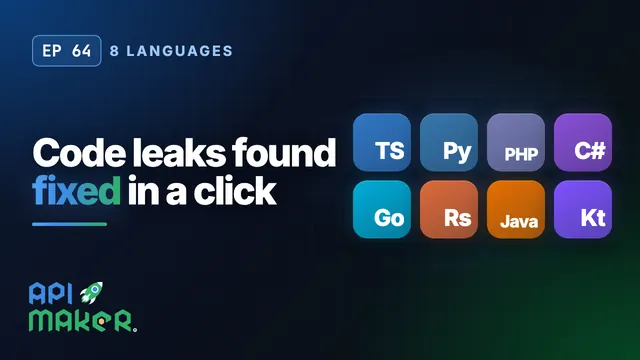 8:4133. Code scan
Scan Your API Code for Leaks in 8 Languages, Fix It in One Click
The APIs Security Report of API Maker reads the code of your account in TypeScript, Python, PHP, C#, Go, Rust, Java and Kotlin, finds what it leaks on its own at its line, and fixes it in one click, in the language it is written in. On Calm Home: TLS checks off, SQL put together from the request, a key in the code, and row scoping hooks graded, rewritten and written in Python and Go. 4:2934. Security
Secure by Default: Encrypted APIs, Allowed Origins, Two-Step Sign-In
Security that ships with the server: encrypted requests and answers, Encrypt Strings for your env file, allowed origins, two-step sign in, and the known vulnerabilities of every package, with a report. The security features of API Maker, on Calm Home. 4:5135. Caching
Automatic API Caching with Redis: One Setting, Under a Millisecond
Some reads make the database do the same work again and again. One setting keeps their answers in Redis, a write drops them on its own, and a read of a table of a million rows answers in under a millisecond. See the cache key, resets from code and headers, and caching for custom APIs.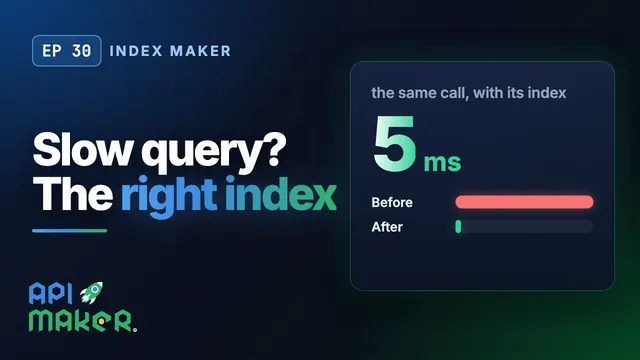 8:4936. Index Maker
Index Maker: Find Slow Queries and Create the Right Index, 6 Databases
Index Maker watches the database queries of your APIs, tells you which ones read a whole table, and gives them the right index, on six database engines. Follow one slow API on a table of a million order events: one run of its custom API in API Testing, a scanning period, query shapes, one verdict on six engines, suggestions ranked by cost, the index form, and the same call fast again. 8:1437. Automatic indexes
Automatic Indexes: Index Maker Indexes Your Database on Its Own
Indexes that find themselves: recorded, decided, written down with a reason, and created in every environment. Turn on the automatic mode of Index Maker, watch its first decision with a reason for every query, then carry its decisions to every environment with the am_index_maker migration script and the index system APIs. 6:2238. Migrations
Database Migrations in TypeScript or Python, Once per Environment
Changes to your databases that run once in every environment, in order, in the language of your team. Write a migration in TypeScript and one in Python, test it first, run the pending scripts from the dialog or from every deploy, and see what each server remembers. 4:3739. Multi-tenant
Multi-Tenant APIs: One Set of APIs, a Database per Tenant
One set of APIs for every customer, each with a database of its own. Keep tenants in a table named by the secret, build a multi-tenant instance with one structure for many databases, pick the tenant by path or header, refuse suspended tenants, and move a tenant with one call. 3:5640. i18n
Translate API Error Messages into Every Language with One Header
Every error of your APIs in the language of the person who called them, without one line of translation in your code. Build a French dictionary, see what a dictionary holds, translate the errors of your own custom APIs, and pick the language with one request header. 3:2841. Masking
Database Name Masking: One Name in Code, Any Database per Developer
Your code names the production database, while your laptop, your staging server and your teammates have other copies. Database name masking keeps one name in the code and lets each account map it to another database: the same address, every API following the mask, and nothing committed to Git. 5:4542. API Testing
API Testing in the Panel: Call, Debug, Export and Share Any API
One page to call any API of your account, change its code and run it, read its logs, and take the request away as code. A tour of the API Testing page: twelve categories, query params and the model of an answer, rows generated from the schema, the answer as a table you can edit and export, keyboard shortcuts, logs, cURL and request states. 5:4843. Test cases
Test Cases with Mocks and Code Coverage for Your Custom APIs
A custom API that works today can break tomorrow with one character. Give Cart Quote four tests with mocks instead of a database, watch one run find a real bug before a customer does, fix it, run them all, see every line the tests ran, and run the same tests with npm run test in your CI. 7:0444. Test cases in depth
Mocks That Fail, Count and Compute : Test Cases in 8 Languages and in CI
The bugs that reach production hide in the paths nobody tests : a database that is busy once, a retry never run. Give Stock Check a mock that fails its call with a 503 for one call, watch the retry run and every line of it covered, answer calls with functions of the test in eight languages, and run the tests of your commit with npm run test, from your repository and in CI. 6:1345. Coverage
Code Coverage of Backend Tests in Eight Languages
Which lines of your backend did the tests really run? Turn on one switch and every run of the test cases counts its lines, in TypeScript, Python, PHP, C#, Go, Rust, Java and Kotlin. See the report of a run, the red lines no test reached, the two tests that cover them, a utility class of Python in the same report, and the same coverage in VS Code, WebStorm and CI. 8:3246. Debugging
Debug an API from the Failing Call to the Line That Broke
Something broke at checkout. Follow one real bug from the failing call to the line that broke, with every debugging tool of API Maker: Log Explorer, stack traces that name the line, Test Hooks, Console Logs View, the queries of one call, Debug Settings, and a breakpoint in your own code. 3:4647. Local client
Code Your Backend in VS Code: Two-Way Sync with the Local Client
The panel is not the only place to write code. The local client keeps a folder on your computer and API Maker in step, both ways, in VS Code, WebStorm or any editor, with the types of your tables in it. A sync token, a clone, npm run start, and every save lands on the other side. 3:4848. AI assistants
Build Your Backend with AI Assistants That Follow One Standard
An AI assistant writes good code when it knows the platform, sees the project and gets checked. See the docs written for assistants and llms.txt, prompts that work, your backend as files with the types of every table, the security report in the repository, and the checks that hold for every line, whoever wrote it. 5:5049. Git
Git Integration: Branches, Commits, Pull and Deploy Hooks for Your Backend
Everything you build in API Maker is text. Put the whole project in a Git repository of yours: connect it, commit, branch, compare changes, pull with a live log, read the history of every item, and let your CI pull through a deployment hook. 3:2450. Dev accounts
Developer Accounts: A Workspace for Every Developer on One Server
A team builds one backend together. With developer accounts, every developer gets a workspace of their own on the same API Maker server, with their own API path, secrets and masks and their schedulers paused, and their work reaches the team through Git. 5:5051. Root & admins
Root User, Admin Accounts and Installation Settings Explained
One API Maker installation can serve many projects. The root user opens an admin account for each one and sets what every server of the installation runs with, from one page: Deployment Settings checked by every server first, where each value comes from, sealed exports and Security Settings.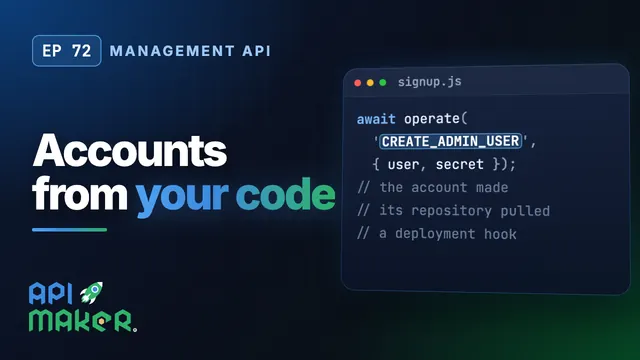 5:0152. Management API
Create API Maker Accounts from Your Own Code: The Management API for SaaS
One call from your sign-up system makes an admin account of API Maker: its Git repository pulled, its secret saved and a deployment hook, with nobody in the panel. Turn the API on, make an account, change its owner and its secret, remove it, read every refusal, and keep the token safe.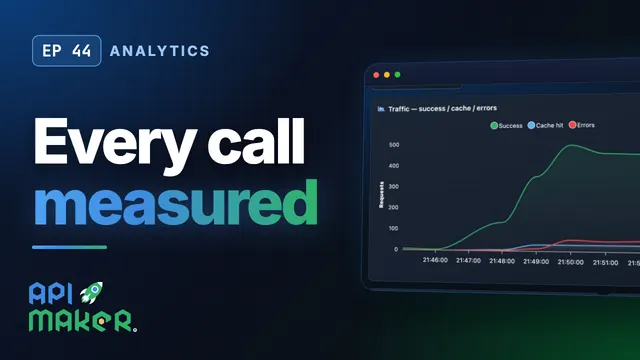 11:5353. Analytics
API Analytics and Monitoring Built In: RED Metrics, p95, Apdex, Live
API Maker measures every call of every API, with nothing to install and no code to write. Read the RED numbers, percentiles and Apdex, follow an error down to the request that caused it, and watch your servers live: memory, disk, Docker, storage and process logs.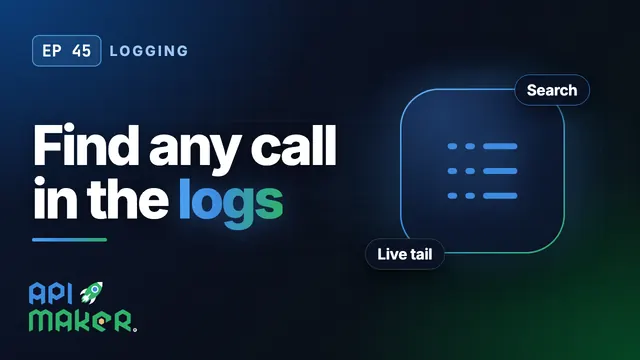 5:1454. Logging
API Logging and the Log Explorer: Search Any Call, Follow Them Live
Every call of your APIs written down: who called, what was sent, what came back, and what the code printed. Choose what is logged with a log profile, search and filter, open the detail of a call, follow calls live, and clean up old logs.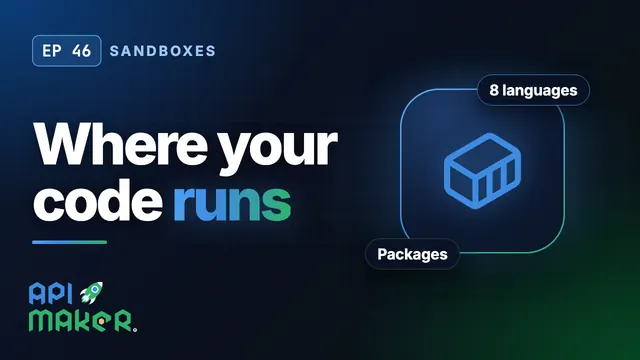 5:2055. Sandboxes
Sandboxes, Runtimes and Packages: Where Your Code Runs
Your code runs in eight languages, each in an image built with the packages it needs, apart from the server and from other accounts. Tour Sandbox Settings: Node.js or Bun, packages from PyPI, npm and NuGet, a Dockerfile of your own with guard rails, and where code runs: lean, sandbox or native. 6:0756. Deploy
Upgrade Every Server from One Page: Deploy API Maker Safely
A new version of API Maker on every server of the installation, from one page of the panel. See how Deploy API Maker installs it from npm or from a bundle, checks its hashes and the program, goes back on its own with a watchdog when the new version does not start, and where Launchpad and the license of each server fit in. 5:3357. SSR websites
Server-Side Rendered Websites with API Maker: First Steps in TSX
API Maker serves websites too: pages written in TSX, rendered by the server right next to your data, edited and previewed in the panel. Make the first pages of the Calm Home shop from a template: files are routes, compiled at the save, and previewed live on every screen size. 6:5558. SSR websites
SSR Websites: Loaders, Forms with CSRF and Customer Sign-In
A website comes alive with data. The Calm Home shop reads four databases in loaders on the server, reads only the tables it lists with rules for their columns and rows, takes a form checked on the server with CSRF built in, and lets customers sign in, each one seeing only their own orders. 6:3659. SSR websites
SSR Websites: Page Cache, SEO, Sitemaps, Images and a Custom Domain
A website has to be fast, found by search engines, and safe with the code and pictures it sends. Give the Calm Home shop a page cache, the head and JSON-LD of every page, robots.txt and a sitemap with every product, a UI library pinned by its hashes, smaller images, and a domain of its own.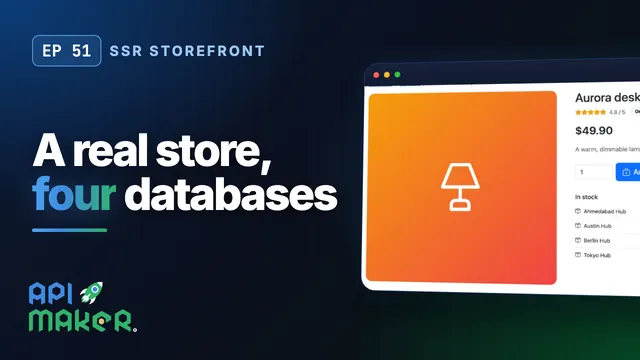 4:5360. SSR storefront
A Real Online Store on Four Databases, Rendered by API Maker
The Calm Home storefront: a real shop on four databases, rendered by API Maker. Walk through it as a customer, from the home page and categories to a product read from four engines, the cart, sign in and an order with its shipment, then read the code of each page and see it on a phone. 4:5561. Developer tools
Developer Tools: Code Finder, Swagger, Redis Dashboard and Shortcuts
The small tools that save hours: one search over all your code, Swagger documents of your APIs, the cache in plain sight in the Redis Dashboard, typed rows from Generated Interfaces, the keys of the panel, and the docs in your language with a cheat sheet.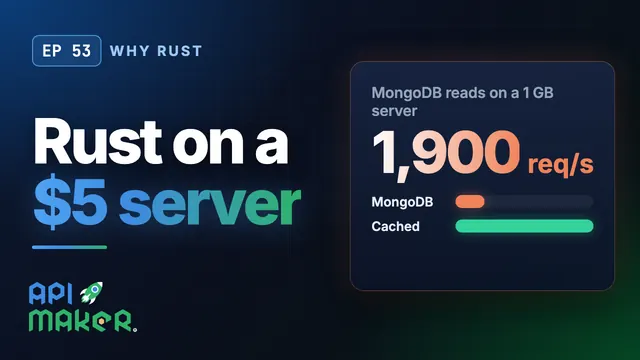 4:5762. Why Rust
Why Rust: API Maker Load-Tested Live on a $5 Server
API Maker is written in Rust. Put it on the smallest server Linode sells, five dollars a month, and load it live: 1,900 requests a second from MongoDB, 9,100 from the cache, memory flat at about 51 MB, and a restart in about a tenth of a second.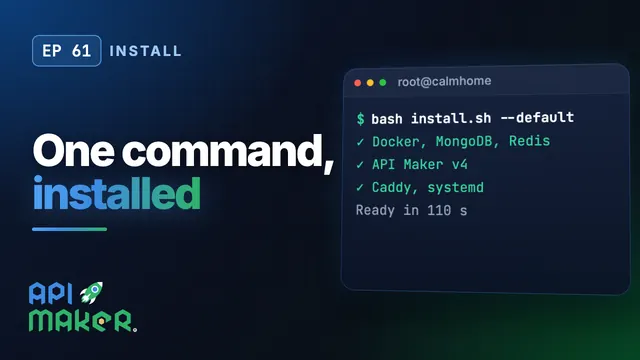 8:0663. Install
Install API Maker v4 on Ubuntu with One Command
One command on a fresh Ubuntu server installs API Maker version four, its MongoDB and Redis, systemd to keep it running, and Caddy in front. A new server of Calm Home goes from nothing to its admin panel in under two minutes, then upgrades with the same command, keeps every version, and grows to more servers. 6:2664. Scale out
Scale Out a Backend: Many API Maker Servers Behind One Load Balancer
Two API Maker servers on the same MongoDB and Redis, behind Caddy: any server answers any call, a save is live on every server at once, WebSocket clients are told whichever server holds them, each scheduler runs once, and a server which stops hands over its clients and schedulers. Shown live, with two servers. 8:5765. Launchpad
Run API Maker on Your Computer with Launchpad, in One Click
API Maker Launchpad is a desktop app that runs API Maker on your computer. Pick a folder: it installs API Maker v4, its MongoDB and Redis, and your databases. One click starts everything, a watchdog stands by, and closing the app stops it all, with nothing left running. 7:1066. Launchpad
Databases on Your Computer: 8 Engines, Any Version, One Click
Databases on your computer with API Maker Launchpad: eight engines in a few clicks, any version Docker Hub has, their instance in API Maker in one click, another version without losing the data, and one file to export and import everything a server holds. 6:0667. Launchpad
Many Projects on One Computer: Tabs, Settings and Your Editor in Sync
Several API Maker projects on one computer, each in its tab and on its own ports. Every setting of a project on one page, a project deleted with everything it made, and your editor kept in sync with API Maker, both ways, with the local client. 6:1468. Cloud mode
Launchpad: Deploy API Maker to Your Own Servers over SSH
The Cloud mode of API Maker Launchpad installs API Maker on servers you rent anywhere, from one server to a load balanced cluster, and keeps them running. Everything happens over SSH from your computer: no agent, a layout to start from, every change reviewed server by server, and a live deployment in stages. 6:5669. Clusters
Design Clusters on a Canvas: Replica Sets, Galera, Gateways and HTTPS
Design a cluster on a canvas: API Maker on several servers behind a gateway, databases clustered over the servers you pick, a MongoDB replica set, MariaDB as a Galera cluster, Caddy, Ferron or Pingap as reverse proxies with their own domains and Let's Encrypt certificates, and every rule checked before anything is deployed. 7:1570. Day two
Launchpad Day Two: Upgrades, Health, Logs and Moving Data Between Servers
Day two with Launchpad: upgrades that say what they will do, the health of every server, a terminal, files and logs without SSH by hand, data moved between servers while it runs with every byte checked, data from your laptop to production in one file, and your Cloud settings sealed in one file. 7:2471. Native APIs
Node.js, Python, Go and Java for Native APIs, Installed for You
Code you mark Run on native process runs on the machine of API Maker, with the language API Maker finds on its PATH. API Maker Launchpad finds what your Mac and your servers have, and installs Node.js, Bun, Python, PHP, Go, Rust, .NET, Java or Kotlin from their publishers, every download checked against its checksum.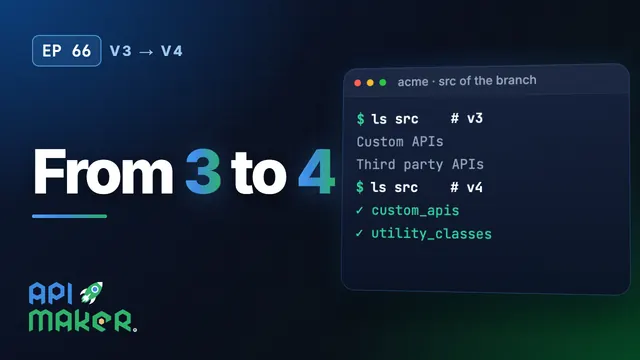 5:3172. Upgrade from v3
Upgrade from API Maker 3 to 4: What Changes in Your Code, Branch and Database
What moving from API Maker 3 to 4 means for a team: what version 4 is, what was removed and what takes its place, a Git branch written by API Maker 3 pulled as it is and written the version 4 way by its first commit, and a database of version 3 opened by version 4. The same data, and the same tokens.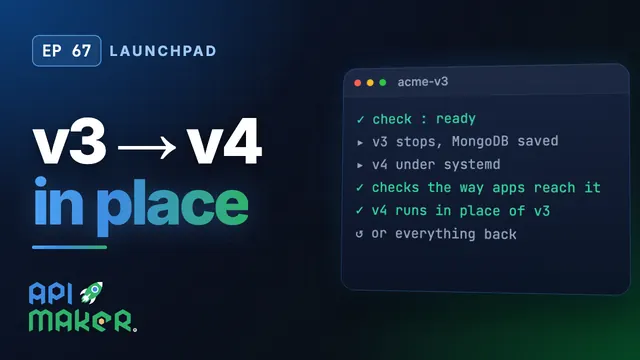 6:2873. Upgrade from v3
Move an API Maker 3 Server to v4 in Place, with API Maker Launchpad
A server of API Maker 3 moved to version 4 where it is, with API Maker Launchpad: a check that changes nothing, servers it can not move refused with the reason, a review of every change to the env file and the Caddyfile, the migration run on the server itself, and everything put back, data included, when anything fails.