

Write APIsEpisode 8 4:38 8 chapters November 2026
Save, Update and Remove on Any Database with the Same API Calls
Save one row or many, update and remove by a filter, push into an array or pull from it: the same calls on every engine. See a batch with one bad row refused before anything is written, the coupons of a festival updated in one call, and a wishlist changed in place on MongoDB.
In the playlists The complete course Generated APIs
Chapters
What you will learn
- One save for one row or many
- One bad row: nothing written
- Update many, and remove by query
- A wishlist on MongoDB: push and pull in place
- The same calls on every engine
Transcript572 words · click a time to play from there
Intro
In API Maker, you can save one row or many, update and remove rows by a filter, and add items to an array. The same calls work on every database. In this video, we make the coupons of a festival, and a wishlist.
Writing data, the usual way
Writing data usually means a lot of code. One insert endpoint for each table, and a loop to save many rows. When one row is wrong, half of the batch is already written. And to add one item to an array, you read the whole array and write it back. With API Maker, one save works for one row or many. The whole batch is checked before any row is written.
And on MongoDB, push and pull change an array in place. In this video: many rows saved at once, one bad row, update many, remove by query, and push and pull.
Several rows at once
Open API Testing. Pick mariadb, then marketing, then coupons, and the API Save single-multiple. We type two coupons for the Festival of Lights, in one array. But the second one has a discount of twenty, written in words. Send. The answer is four hundred, with the field and the reason. And neither coupon is saved, because the whole array is checked first. We change twenty into a number. Send again.
The answer is two hundred and one. Both coupons are saved, and the database gave them their numbers.
Many rows at once
Now pick Update many. In find, we give the two codes. In data, we set a thousand uses for each. Send. updatedRowsCount is two. One call changes every row the find matches. Now pick Remove by query, with the same find, and returnData set to true. Send. deletedRowsCount is two. With returnData, you also get the rows as they were, with their IDs. That is enough to log what was removed, or to put it back.
Without returnData, you get only the count. That is faster when many rows go.
Arrays of MongoDB
Now MongoDB, with the wishlists. We save a wishlist of a customer, called Festival gifts, with the Ash nightstand in it. It is saved. Pick Array operations. The body says which document to change, and what to do. The find picks the wishlist by its name. Then, in operations, we push to the path items, with dataToPush: the Glow strip. Send. Now there are two items. To remove one, pull takes a queryToRemove instead.
Here, the product ID of the nightstand. Send. One item is left. The document is changed in place. It is never read and written back whole.
Good to know
Good to know. Update by ID changes one row, and replace by ID replaces a whole MongoDB document. Master save writes rows of many tables, across databases, in one call. Video nine shows it. Every write of a SCHEMA API goes through the schema: changes of type, rules, and encryption. Videos three and four show them. And a write clears the cached answers of its table. Video twenty nine shows it.
Built on standards
One shape of write, on every database. A batch is checked before a single row is written. So a client, or an AI assistant, never leaves half a batch behind.
Recap
To sum up. One save, for one row or many. One bad row, and nothing is written. Update many, and remove by query. Push and pull, in place. Next: master save, a tree of rows across databases, in one call. API Maker. Build faster, spend smarter, deliver better.
Keep watching
 Length 3:45Master save
Master Save: Write a Tree of Rows Across Databases in One Call
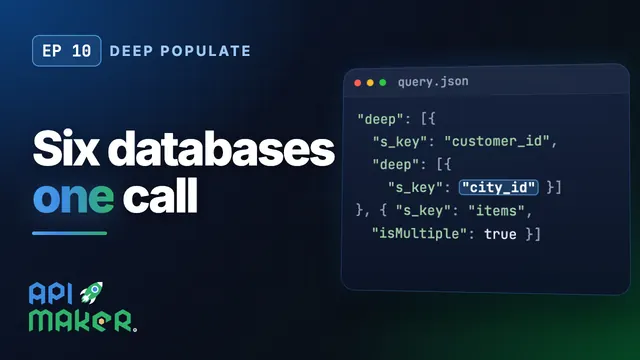 Length 9:25Deep populate
Deep Populate: Join Data Across Six Databases in One API Call
 Length 5:24Virtual fields
Virtual Fields: One-to-Many Relations Across Databases
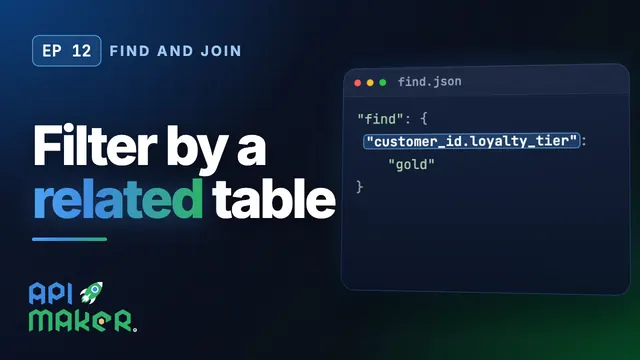 Length 5:09Find and join