
Playlist · 9 videos · 45 min
Generated REST APIs: read, write and relations
The APIs every table gets without code: one query language for six databases, writes, master save, deep populate, virtual fields, find and join across databases, and request headers that shape every answer.
The videos of this playlist
 4:191. Generated APIs
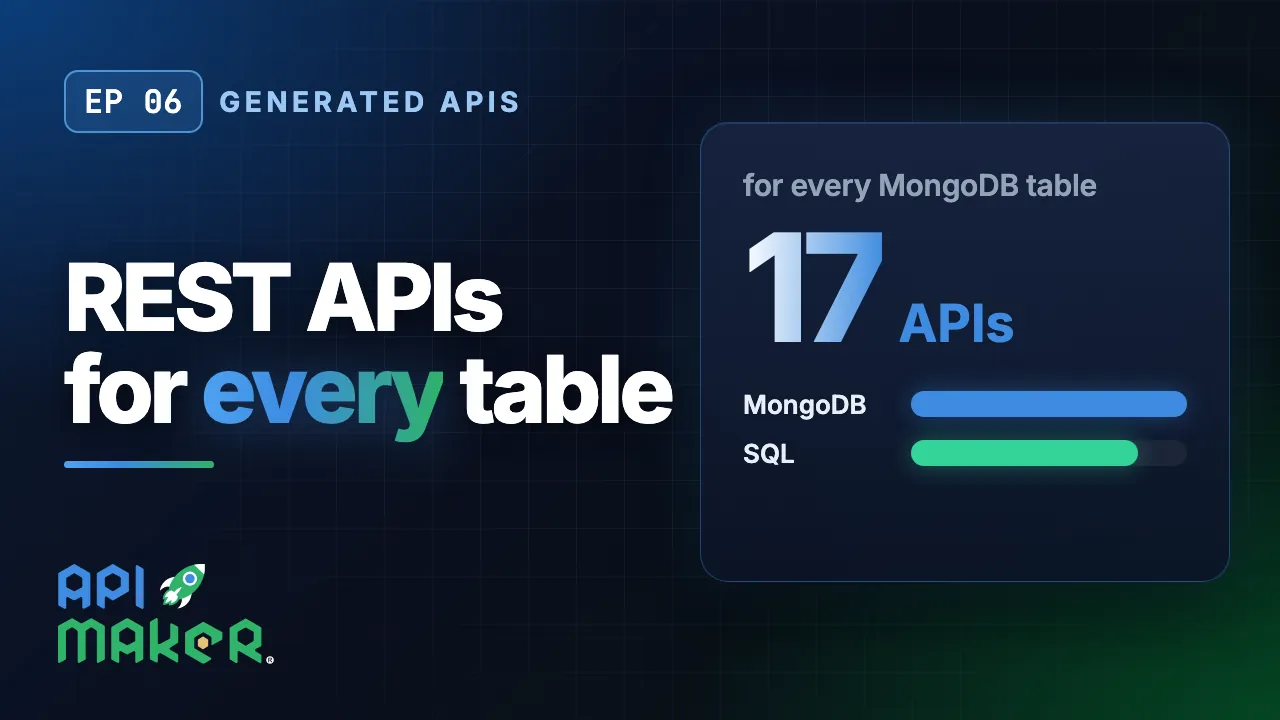
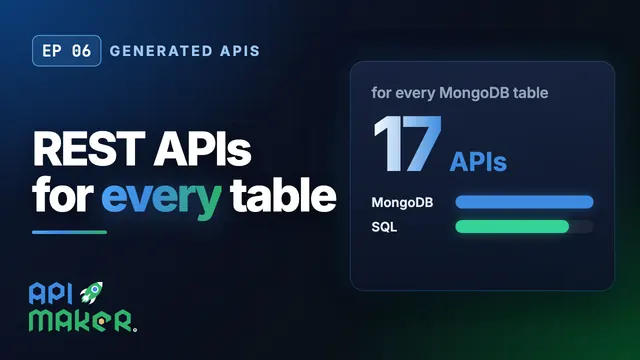
Instant REST APIs for Every Table: A Tour of the Generated APIs
Every table answers REST APIs without a line of code: seventeen operations on MongoDB and fourteen on SQL, in two families, SCHEMA and GEN, with one envelope for success and error. Take the tour from the panel, from a terminal with curl, and in the Swagger docs of an application.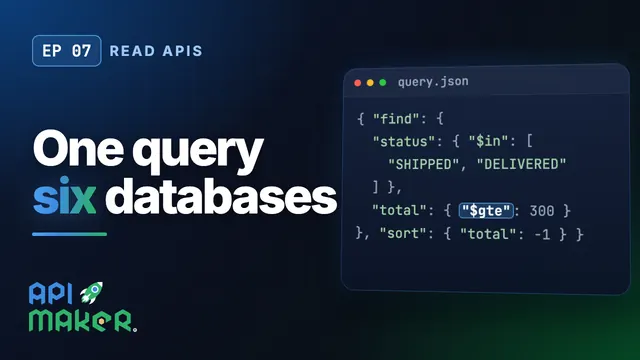 5:012. Read APIs
One Query Language for Six Databases: find, select, sort, aggregate
Read data the same way on MongoDB, MySQL, PostgreSQL, SQL Server, Oracle and MariaDB: find, select, sort and limit, with the operators of MongoDB, on every engine. See one query asked in three dialects, every operator on SQL, count, distinct, an aggregate, and a million rows streamed. 3:253. Write APIs
Save, Update and Remove on Any Database with the Same API Calls
Save one row or many, update and remove by a filter, push into an array or pull from it: the same calls on every engine. See a batch with one bad row refused before anything is written, the coupons of a festival updated in one call, and a wishlist changed in place on MongoDB. 3:164. Master save
Master Save: Write a Tree of Rows Across Databases in One Call
One call writes a tree of rows: a customer in PostgreSQL, her order and its lines in MySQL. Each row gets the id it needs, and when one row is wrong, nothing is written in any database. Then the whole tree is read back with deep.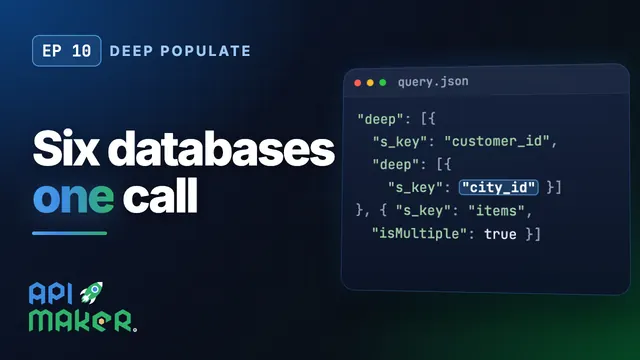 8:435. Deep populate
Deep Populate: Join Data Across Six Databases in One API Call
Deep populate swaps the ids in your rows for the rows they point to: one call, any depth, in one database or across six engines. An order comes back with its customer and city from PostgreSQL, its coupon from MariaDB, its employee from Oracle, its lines from MySQL with their products from MongoDB, and its shipments from SQL Server. 4:516. Virtual fields
Virtual Fields: One-to-Many Relations Across Databases
Deep fills an id with the row it points to. A virtual field goes the other way: the rows of another table that point back here, like the orders of a customer, in one call, even from another database. Declare it in the schema, read a customer with their orders, reviews and tickets from three databases, and shape every level.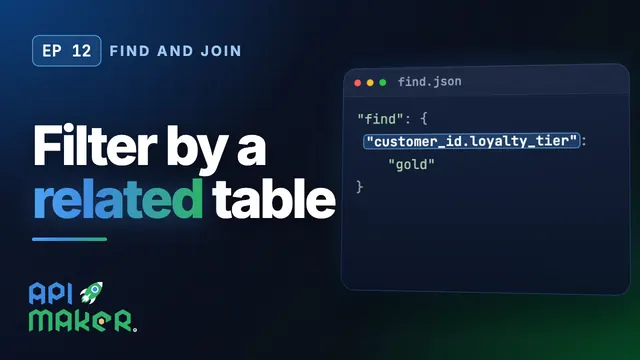 4:167. Find and join
Filter by a Related Table, Even in Another Database: Find and Join
Filter rows by a related table, even when it lives in another database: a dot in find follows the relation, like customer_id.loyalty_tier. See it in one database, across two engines and three, why the innermost table is queried first, and the same in counts and updates. 3:518. Request headers
Shape Every API Answer with Request Headers: camelCase, XML, YAML, Flat
The client chooses the shape of the answer, with no code on the server: the case of its keys, JSON, XML or YAML, nested or flat, with its timing in meta, encrypted, or compressed. One request header each, on every API of API Maker.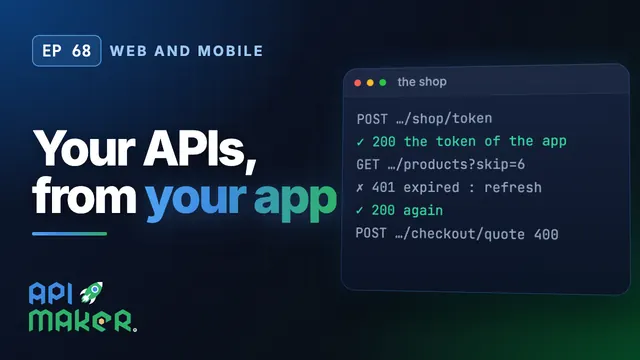 7:369. Web and mobile
Call Your API Maker APIs from a Web or Mobile App: Tokens, CORS, Errors and Types
A real web shop in plain JavaScript calls API Maker from the browser: the token of the app from a public custom API (the password stays in the secret), pages of products with select, sort, limit, skip and the total, a customer who signs in for a token of their own, an expired token refreshed without the customer noticing, errors shown under their fields, allowed origins, types from the schemas, and the same calls from Swift and Kotlin.