

Upgrade from v3Episode 66 6:18 11 chapters November 2026
Upgrade from API Maker 3 to 4: What Changes in Your Code, Branch and Database
What moving from API Maker 3 to 4 means for a team: what version 4 is, what was removed and what takes its place, a Git branch written by API Maker 3 pulled as it is and written the version 4 way by its first commit, and a database of version 3 opened by version 4. The same data, and the same tokens.
In the playlists The complete course Run in production Upgrade from v3
Chapters
What you will learn
- What version 4 is: one Rust program, eight languages, one port, the panel served by API Maker
- What was removed (UI Maker, the store and its third party APIs, x-am-secret, notes) and what to use instead
- A branch of API Maker 3 pulled into an account of version 4: the parts left out, the packages named for you
- Why every package a sandbox uses is now listed in Sandbox Settings
- The first commit: the custom APIs in their folders of today, their history kept
- What version 4 does once with a database of version 3
- What to check before moving your servers, and the two ways to move them
Transcript875 words · click a time to play from there
Intro
Here is the move from API Maker 3 to 4. You see what changes on your servers, what was removed and what takes its place, and what happens to your Git branch and your database. The data stays the same, and so do the tokens.
A new major version, the usual way
A new major version of a backend usually means code rewritten for a new framework, data to migrate, new tokens for every app, and a weekend with no way back. Here, the same APIs run on the same data. The tokens stay the same. Your branch is pulled as it is. And there is a short list of things to check. In this video: what version four is, what was removed, your branch, pulled, its packages, the first commit, your database, what to check, and your servers.
What version four is
Version four is the same framework, rebuilt in Rust. It is one program, with one process for each server, and a thread for every core. Code runs in eight languages, each with its own packages and runtime. The APIs and the WebSockets share one port. Behind Caddy, nothing changes for your apps. And API Maker itself serves the admin panel, so api_maker_fe is gone.
What was removed
Some parts of version three are gone. UI Maker is gone. Build your screens as SSR websites, or in your own frontend. The store and its third party APIs are gone, but their utility classes and packages stay, because the pull keeps them. The header x-am-secret is gone since three point three. Code reads its secrets with getSecret. The Register page is gone, because root makes the accounts. Notes are gone too.
And nothing is installed in a sandbox unless the account lists it, in the packages of its language.
Your branch, pulled
Acme ran API Maker 3. Lena, their developer, first tries their branch on its own account of version four. Open Git Integration. It shows the repository of Acme, and main, its working branch. Click Pull. The account takes what the branch holds. Say yes, and the steps on the server show live. There is a warning: this branch was written by API Maker 3. The panel lists what was not pulled: the third party API, and a form of UI Maker.
lodash and moment, which every sandbox of version three had, are now packages of the account, at the same versions. So is the S3 client that the third party API brought. Its three custom APIs are there.
Its packages
Open Sandbox Settings, then JavaScript. There are the three packages, each at the version API Maker 3 had. From now on, a package the code uses must be listed here, or it is not installed.
The first commit
The first commit writes the branch the way version four does. Click Check status. The custom APIs move to their new folders, and the panel marks them Modified. They are the same items, under their new names. When collapsed, you see the changes by part. Deleted shows the parts that version four does not have. Added shows the files that every project of version four has. Pick all of them.
Write a message: the branch, written by API Maker 4. Commit to main, and confirm. Nothing is left to commit. In the repository, there are two commits: the one API Maker 3 wrote, and the first one of API Maker 4. Before it, the parts have their old names, like Custom APIs, with a space. After it, they are custom_apis and utility_classes, with nothing from UI Maker or the store.
And Git follows the code of Order Age across the move, so both commits are in its history.
Your database
A server of version four, started on the database of version three, does the same once, for every account. It lists the packages that the code uses, and gives each WebSocket event back the code that says who can connect. A database that version three never ran on is left as it is. If the secrets of the env file are kept, as the installer and Launchpad keep them, the data stays the same, and so do the tokens of your apps.
What to check
Before the move, try your branch on its own account of version four, as Lena did. Run your test cases, as in videos thirty seven and sixty three, and the security report, as in video twenty seven. Sandboxes now run Debian, not Alpine. So a system program that your code calls goes in the Dockerfile of its language. And keep a copy of the database until you are sure.
Your servers
Then come the servers. On the server itself, the installer of video sixty one moves it in place. Or from your computer, use the V3 to V4 Migration of Launchpad, in the next video. It checks everything first, and puts everything back if anything fails.
Recap
To sum up. Version four is one program in Rust, with eight languages, one port, and the panel served by API Maker. UI Maker and the store are gone, but their packages and utility classes stay. A branch of version three is pulled as it is, and the first commit writes it the version four way. The data stays the same, and so do the tokens. Next: a server moved in place, with Launchpad.
API Maker. Build faster. Spend smarter. Deliver better.
Keep watching
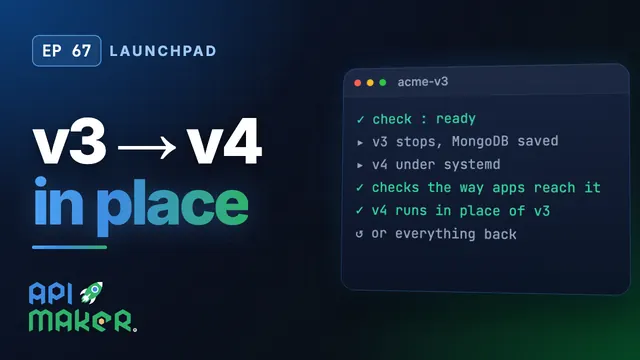 Length 7:42Upgrade from v3
Move an API Maker 3 Server to v4 in Place, with API Maker Launchpad
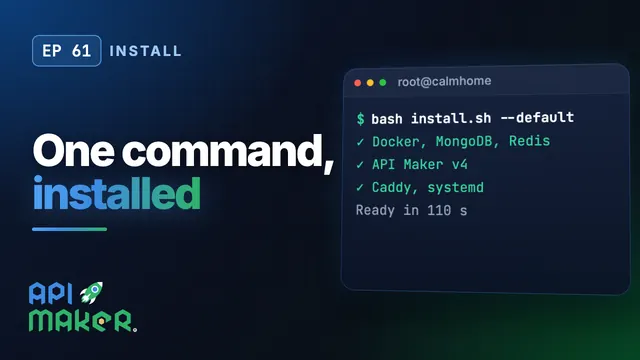 Length 8:37Install
Install API Maker v4 on Ubuntu with One Command
 Length 6:28Git
Git Integration: Branches, Commits, Pull and Deploy Hooks for Your Backend
 Length 6:32Test cases