Grants that cascade
A group grants an instance, a database, a table, one generated API of a table, or single fields. Custom and system APIs, events, schedulers and WebSocket events are granted by name.
API Maker
The framework for AI era

Security
Role-based access down to the field: who can call which API, and which fields they read or write.
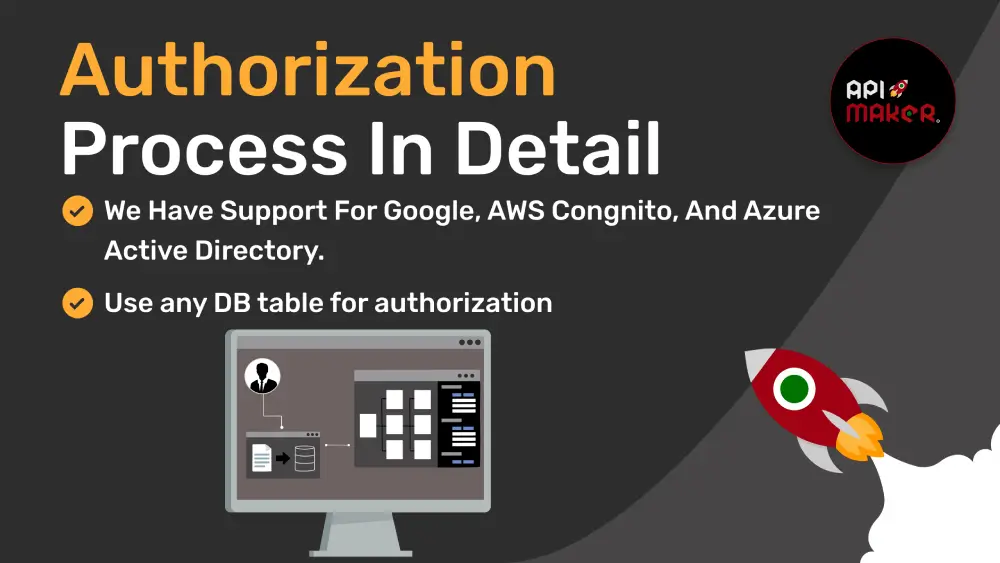
Every call carries an API user token, and often a user token for the person behind it. Groups say what they may do: which instances, databases, tables and APIs, and which fields they can read or write. API Maker checks it on every request, and a change to a group applies to the next one.
Step through it, slow it down, or open the full canvas.
 api-maker/features/access-managementLive
Users get their access from groups. A group allows APIs: generated APIs of some tables or all of them, custom and system APIs. A user can be in several groups.
A group allows APIs: generated APIs of some tables or all of them, custom and system APIs. A user can be in several groups.
priya's groups allow reading orders, not deleting them. The delete stops with 403 before anything runs.
Analysts can read name and email of employees, not salary. salary is removed from every response omar gets.
Querying on salary, or writing email without write access, returns 403 with the field and the group in the message.
A request without a valid token gets 401. Give Analysts read on salary and omar's next request already includes it: no restart.
A group grants an instance, a database, a table, one generated API of a table, or single fields. Custom and system APIs, events, schedulers and WebSocket events are granted by name.
Fields without read access leave every response. Writing a field, or filtering on it, without access is refused with 403.
Sign in the users of your own users table and get a user token. Its groups column says which groups apply; * gives all the groups of the API user.
Accept Google, Azure AD and AWS Cognito tokens, or your own token logic, and map those users to groups too.
Pre hooks restrict the rows a user reaches, for example to their own company, and can be skipped for a group of managers. The APIs Security Report finds tables without one and adds it in one click.
Change a group and the next request uses it. 401 means the token is missing or invalid, 403 that no group grants the call.
Everybody reads names and emails of employees, managers also read salaries, and only HR can change them. Three groups express it, the same APIs serve every screen, and nobody writes permission checks in code.
GET /api/schema/admin/hr/main/employees?select=name,email,salaryx-am-authorization: <API user token of the app>x-am-user-authorization: <token of the person>If the groups of the person can not read salary, the answer comes without it.
POST /api/system-api/admin/token{ "name": "app_users", "u": "[email protected]", "p": "••••••••" }app_users is the name of the auth provider that points to your users table. The answer holds the token, a refresh token and its expiry.
x-am-authorization identifies the application with an API user created in API Maker. x-am-user-authorization identifies the person, a row of your users table, whose groups column decides which groups apply to the call.
Yes. Set its access type to IS_PUBLIC. NO_ACCESS keeps an API for your own code only, TOKEN_ACCESS (the default) needs a token.
In API Maker, or in your secret: an API user can read its password from a path of the secret.